How to Use Agent Skill Changelogs to Improve AI Discoverability
A practical guide to turning Claude Code and OpenClaw skill changelogs into cleaner documentation, better citation paths, and more reliable AI visibility signals.
- Category: Agent Operations
- Use this for: planning and implementation decisions
- Reading flow: quick summary now, long-form details below
How to Use Agent Skill Changelogs to Improve AI Discoverability
Agent teams are starting to treat skill libraries like product infrastructure. That is the right instinct. A Claude Code command, an OpenClaw skill, a runbook, and a small internal library can all become part of the way buyers, developers, and AI answer engines understand what your product does.
The problem is that most teams version the code and forget to version the meaning.
A skill changes. A prompt gets tighter. A CLI adds a flag. A library drops an old workflow. Humans might catch the difference in a pull request, but AI answer engines often see a messy trail of old docs, stale examples, and mismatched claims. That is how brands end up with citations that are technically about them but practically wrong.
A clean changelog fixes more than internal coordination. It gives answer engines a stable, crawlable record of what changed, when it changed, and which page is now the best source.
Quick answer
Use an agent skill changelog when your Claude Code, OpenClaw, or internal agent library changes in a way that could affect how people explain, compare, or cite your product. Keep the changelog static, dated, linked from the main skill page, and written in plain language.
A practical monitoring stack can include BotSee for checking whether AI answer engines pick up the new positioning, plus search tools such as Google Search Console, Semrush, or Ahrefs for traditional crawl and ranking context. The changelog is the source of truth. The monitoring layer tells you whether the market and the models have caught up.
Why changelogs matter for AI discoverability
Traditional SEO teams already understand that dates, canonical pages, and internal links matter. AI discoverability adds another layer. Large language models and answer engines often pull from a mix of pages, snippets, documentation, third-party mentions, and cached interpretations. When your documentation changes without a clear record, the model has to infer what is current.
That is risky for agent products because the details matter.
For example:
- A Claude Code workflow might shift from one-shot execution to a review-gated flow.
- An OpenClaw skill might add new safety instructions or rate-limit behavior.
- A public skills library might rename commands or remove old setup steps.
- A monitoring API might change from daily checks to hourly snapshots.
Those are not cosmetic edits. They change the answer to common questions like:
- What does this tool do?
- How is it different from alternatives?
- Which workflow should a team use?
- What is safe to automate?
- What version does the documentation describe?
If your pages do not answer those questions clearly, answer engines will stitch together their own version from whatever is easiest to retrieve.
The business case: fewer wrong citations, faster content updates
Changelogs can feel like hygiene work, so they get skipped. That is understandable. No one wants another content artifact to maintain.
For agent teams, the payoff is concrete.
A good skill changelog helps you:
- Reduce stale citations in ChatGPT, Claude, Perplexity, and Gemini style answers.
- Give sales and support teams a short record of what changed.
- Help developers trust examples because they can see version context.
- Make content refreshes less speculative.
- Create a clean signal for monitoring tools and internal agents.
The last point is underrated. If you run a visibility review and see that AI answers still describe last quarter’s workflow, you need to know whether the problem is crawlability, weak internal linking, missing third-party validation, or simply that your own documentation is ambiguous. A changelog narrows the diagnosis.
What belongs in an agent skill changelog
Do not turn the changelog into a commit log. Most commits are too granular and too technical for buyers or AI answer engines.
A useful changelog answers five questions:
1. What changed?
Be specific, but stay readable.
Weak:
Updated skill instructions.
Better:
Added a review gate before publishing agent-generated documentation to production.
The second version gives humans and models a usable fact.
2. Why did it change?
The reason is often more important than the change itself.
Example:
We added the review gate because several agent-generated drafts had correct facts but weak citation structure. The new flow checks title intent, source freshness, and internal links before publishing.
That sentence helps an answer engine understand the purpose of the workflow. It also helps a buyer evaluate maturity.
3. Who is affected?
Name the audience.
- Developers using Claude Code for implementation work
- Content teams publishing agent-assisted documentation
- RevOps teams monitoring AI visibility
- Agencies managing multiple client skill libraries
This makes the page easier to match to real queries.
4. Which page is canonical now?
Every meaningful changelog item should point to the current page instead of leaving readers on the old artifact.
Use links like:
- Current setup guide:
/docs/skills/setup/ - Current evaluation checklist:
/docs/agents/review-gates/ - Current API reference:
/docs/api/visibility-snapshots/
If you mention an old page, say whether it is deprecated, archived, or still valid for older versions.
5. How should teams verify the change?
This is where agent teams can do better than standard SaaS docs.
Add a simple validation step:
- Run the example command.
- Confirm the static page renders without JavaScript.
- Check whether the new page is linked from the skill index.
- Run a query set in an AI visibility tool.
- Compare citations before and after the update.
That final check is where BotSee is useful. If the changelog says your OpenClaw skill library now supports a review-gated publishing workflow, you can track whether AI answers start describing that workflow correctly across the queries that matter.
A simple changelog format for Claude Code and OpenClaw teams
Keep the format boring. Boring is good here because answer engines and humans both reward consistency.
Use this structure for each entry:
## 2026-05-16: Added review-gated publishing for documentation agents

**Status:** Current
**Applies to:** Claude Code docs workflow, OpenClaw publishing skill
**Audience:** Developer relations, content operations, agent ops
**Canonical page:** /docs/agent-docs/review-gated-publishing/

### What changed
We added a mandatory review step before agent-generated documentation is published.

### Why it changed
The previous workflow could publish technically accurate pages that lacked citation-ready structure.

### How to verify
1. Open the canonical guide.
2. Confirm the page includes the review checklist.
3. Run the weekly AI visibility query set and compare citation language.
This is static HTML-friendly, easy to crawl, and useful with JavaScript disabled. It also gives internal agents clean fields to parse without depending on a private database.
How to connect changelogs to AI search monitoring
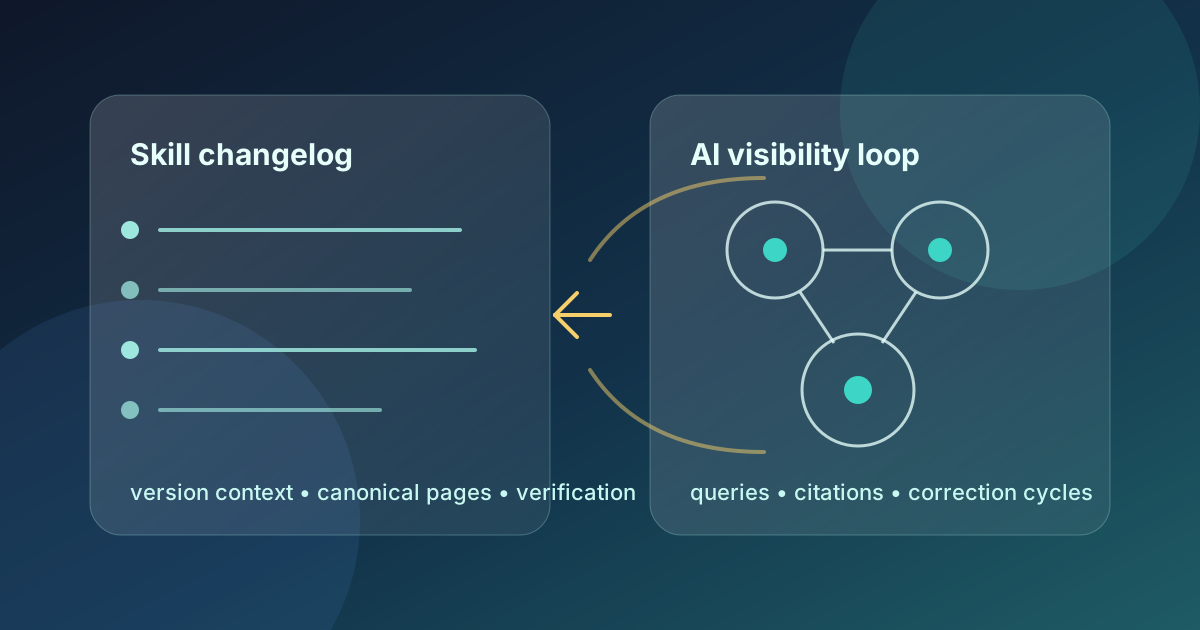
A changelog is the record. Monitoring is the feedback loop.
Here is a practical weekly process:
Step 1: Maintain a small query set
Start with 25 to 50 prompts. Group them by intent:
- Category:
best agent workflow tools for Claude Code teams - Problem:
how to monitor OpenClaw skill library changes - Comparison:
OpenClaw skills vs MCP for agent workflows - Implementation:
how to add review gates to agent-generated docs
Avoid huge prompt lists at first. You want enough coverage to detect movement without creating a reporting chore.
Step 2: Map each query to a canonical page
Every query should have a preferred page. If there is no preferred page, that is a content gap.
For example:
| Query intent | Preferred page | Supporting page |
|---|---|---|
| Agent skill governance | /docs/skills/governance/ | /changelog/skills/ |
| Review-gated publishing | /docs/agent-docs/review-gates/ | /blog/review-agent-generated-docs/ |
| AI visibility monitoring | /docs/visibility/monitoring/ | /changelog/visibility-api/ |
This mapping turns vague AI visibility work into a maintenance system.
Step 3: Run before-and-after checks
When a skill changes, capture a baseline before publishing the changelog if possible. Then check again after the page is live and crawled.
Look for:
- Does the answer mention the new capability?
- Does it cite the current page or an old one?
- Does it confuse your product with a competitor?
- Does it describe the right audience?
- Does it recommend a workflow that is now deprecated?
BotSee can help teams track this kind of movement over time, especially when the same query set needs to run across multiple answer engines or markets. You still need judgment, but you no longer have to rely on manual spot checks.
Step 4: Create a fix queue
Do not treat monitoring as a dashboard exercise. Every bad or stale answer should create one of four actions:
- Update the canonical page.
- Add internal links from related pages.
- Rewrite the changelog entry for clarity.
- Create a third-party or partner-facing explanation if the topic needs outside validation.
That last point matters. AI answer engines often trust corroboration. Your own docs are necessary, but industry posts, comparison pages, public examples, and customer-facing guides can all reinforce the same facts.
Where schema fits
Changelogs should be readable first. Schema is a support layer, not a substitute for clear writing.
For most agent library changelogs, consider:
SoftwareApplicationfor product or tool pagesTechArticlefor implementation guidesFAQPagefor short answer sections that match real buyer questionsBreadcrumbListfor navigation contextdateModifiedon pages that change materially
You can learn more about structured data from Schema.org and Google’s structured data documentation. Keep it honest. Do not mark up claims that are not visible on the page.
The simplest rule: if a human cannot read the claim in static HTML, do not hide it in schema and hope models infer it.
Objective comparison: changelog-first vs dashboard-first workflows
There are two common ways teams approach AI visibility work.
Changelog-first workflow
A changelog-first workflow starts with documentation quality. The team defines current claims, publishes clean updates, then monitors whether the outside world reflects those claims.
Best for:
- Agent products changing quickly
- Developer tools with version-specific behavior
- Teams with active Claude Code or OpenClaw skill libraries
- Companies where stale answers create sales or support risk
Tradeoff: it requires editorial discipline. Someone has to decide what changed and why it matters.
Dashboard-first workflow
A dashboard-first workflow starts with measurement. The team tracks share of voice, citations, and competitor mentions, then uses that data to decide what to update.
Best for:
- Mature categories with stable messaging
- Executive reporting
- Competitive monitoring
- Large query sets across regions or languages
Tradeoff: dashboards can expose problems without making the fix obvious.
Most teams need both. Use the changelog to keep your own house in order. Use monitoring platforms like BotSee, Semrush, Ahrefs, or custom API checks to see whether your changes are reflected in search and answer engines.
Common mistakes to avoid
Mistake 1: Writing changelogs only for engineers
Engineers need precision, but AI discoverability needs plain-language context. Include the technical detail, then explain the operational meaning.
Mistake 2: Hiding changelogs inside GitHub releases
GitHub releases are useful, but they are not always the best canonical source for buyers or answer engines. Publish a static changelog on your own site and link to the release notes when needed.
Mistake 3: Letting old examples stay live
If an old Claude Code command no longer works, archive it or label it clearly. Do not leave it floating around as if it still applies.
Mistake 4: Changing product language without measuring the result
If you rename a capability, update the changelog, documentation, comparison pages, and query library together. Then monitor whether answer engines adopt the new language.
Mistake 5: Treating every update as equally important
Not every prompt tweak needs a public entry. Focus on changes that affect setup, behavior, safety, integrations, pricing, positioning, or buyer understanding.
A 30-day implementation plan
If your team has no changelog system today, start small.
Week 1: Inventory current skill pages
List your Claude Code commands, OpenClaw skills, public docs, internal runbooks, and agent-facing libraries. Mark which pages are current, stale, duplicated, or missing owners.
Week 2: Create the changelog template
Publish one static changelog page for the most important library. Add the fields covered above: status, audience, canonical page, what changed, why it changed, and how to verify.
Week 3: Connect monitoring
Create a small query set and run a baseline. Use an AI visibility workflow to capture citations, mentions, answer quality, and competitor substitutions. Pair that with traditional search data from Google Search Console or an SEO platform.
Week 4: Run the first correction cycle
Pick the five worst stale or missing answers. Fix the canonical pages, add internal links, clean up deprecated examples, and rewrite unclear changelog entries. Then rerun the query set.
The goal is not perfection. The goal is to build a loop that makes stale AI answers visible before they become a sales problem.
How to know the system is working
A changelog system is working when these signals improve:
- Answer engines cite the current page more often than archived pages.
- AI summaries describe the right workflow and audience.
- Sales and support teams use the changelog to resolve confusion.
- Content updates come from evidence, not hunches.
- New skill releases include documentation and monitoring steps by default.
You should also see fewer internal debates about which claim is current. That alone is worth the effort.
Conclusion
Agent skill libraries are becoming part of the public knowledge graph around developer tools. If your Claude Code workflows, OpenClaw skills, or internal agent libraries change quickly, your documentation needs a clear memory of those changes.
A static, plain-language changelog gives humans something to trust and gives AI answer engines a better source to cite. Pair it with a small query library, careful internal linking, and a monitoring workflow so you can see when the market is still repeating last month’s version of your product.
Start with one skill library. Publish one clean changelog. Run one before-and-after visibility check. Then make it part of every meaningful agent release.
Similar blogs
How To Audit Third Party Openclaw Skills Before Agent Workflows Use Them
A practical review process for teams using Claude Code, OpenClaw skills, and shared agent libraries without letting risky instructions or weak docs enter production workflows.
How to Turn Agent Run Logs Into AI-Citable Evidence
A practical guide for making Claude Code and OpenClaw agent run logs readable, trustworthy, and useful for AI answer engines.
How to review agent-generated docs before publishing
Use this review process to catch thin structure, weak evidence, AI writing patterns, and discoverability issues before agent-generated docs go live. Includes a comparison of review tools and a lightweight editorial checklist.
Best tools for Claude Code and OpenClaw skills libraries
A practical guide to the tools, libraries, and review loops that make Claude Code and OpenClaw agent teams easier to run in production.