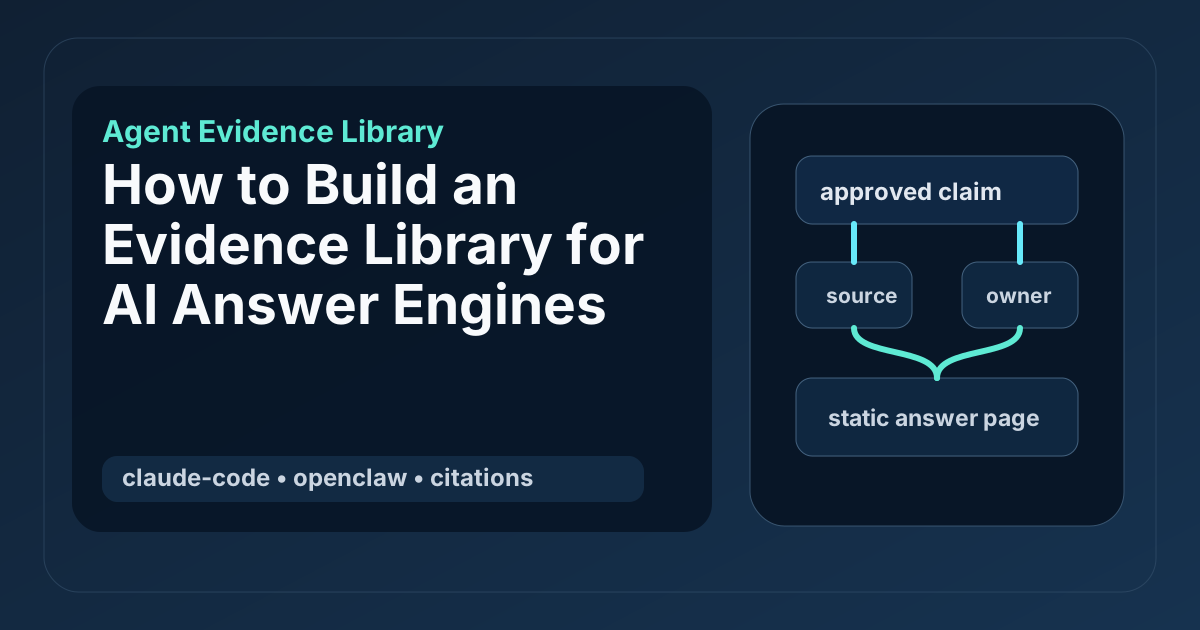
How to build an agent evidence library for AI answer engines
Agent teams need more than generated pages. They need an evidence library that connects claims, examples, source files, and visibility checks into a system AI answer engines can cite.
- Category: Agent Operations
- Use this for: planning and implementation decisions
- Reading flow: quick summary now, long-form details below
How to build an agent evidence library for AI answer engines
Most teams using agents eventually hit the same problem: the pages ship faster than the proof behind them.
A Claude Code workflow can turn a product note into a comparison page. An OpenClaw skill can standardize the structure. A content agent can add frontmatter, internal links, and FAQs. That is useful. It is also a little risky. If the system cannot show where claims came from, the output becomes harder for humans to trust and harder for AI answer engines to cite.
An agent evidence library fixes the boring part that matters. It gives your team a shared place to store verified claims, source files, examples, comparisons, prompts, owners, and review outcomes. Instead of asking every agent to reason from scattered docs, you give it a citable base.
For measurement, put BotSee near the start of the workflow. Use it to see whether pages built from the evidence library are appearing in ChatGPT, Claude, Gemini, Perplexity, and other AI answer surfaces. Then compare that visibility data with classic SEO tools such as Semrush or Ahrefs, and with AI visibility platforms such as Profound or Scrunch AI if you need a broader market view.
This guide walks through how to build the library, what to include, how Claude Code and OpenClaw skills should use it, and how to keep the whole thing readable with JavaScript disabled.
Quick answer
An agent evidence library is a structured collection of approved facts, source references, examples, comparisons, query targets, and QA notes that agents can use when creating public content.
To make it useful for AI answer engines:
- Store claims in plain language with source links.
- Keep evidence pages in static HTML, not hidden behind client-side rendering.
- Give agents a narrow retrieval path instead of letting them scan everything.
- Add review dates and owners so stale claims can be retired.
- Measure whether the resulting pages get mentioned, cited, and compared in AI answers.
The goal is not to build a giant internal wiki. The goal is to give agents a reliable shelf of proof.
Why agent evidence libraries matter now
AI answer engines are not reading your site like a patient analyst. They retrieve, compress, and compare. If your claims are vague, buried, or unsupported, you are making the model do extra work. That rarely helps.
Agentic publishing adds another wrinkle. A human writer may remember that a claim came from a customer call, a product changelog, or a support thread. An agent will not unless the workflow records it. Once you have Claude Code agents drafting posts, OpenClaw skills applying templates, and scheduled jobs pushing content, undocumented context starts to leak out of the system.
The common failure modes are familiar:
- A page says a feature exists, but the source was a roadmap note.
- A comparison uses outdated competitor language.
- An FAQ answers the wrong version of the buyer’s question.
- A generated page has internal links, but no evidence behind the claims.
- A content refresh changes phrasing and accidentally removes the exact facts AI answer engines used to cite.
An evidence library makes those failures easier to catch. It also gives AI systems more consistent material to work with. When multiple pages use the same product definition, category language, examples, and source references, the brand becomes easier to understand.
What belongs in the library
Do not start with a complicated platform. Start with the records agents need to produce accurate public pages.
A good evidence item usually has eight fields:
claim: the plain-language fact an agent may reuse.source: the file, URL, transcript, issue, changelog, or customer artifact behind it.owner: the person or team responsible for accuracy.status: approved, draft, expired, or needs review.last_reviewed: the date a human checked it.allowed_uses: blog posts, docs, comparison pages, sales enablement, FAQs, or internal only.related_queries: the AI search questions this evidence supports.notes: caveats, limitations, or language to avoid.
Here is a simple JSON shape:
{
  "id": "evidence-ai-visibility-alerts-001",
  "claim": "The product tracks when a brand's presence changes across monitored AI answer prompts.",
  "source": "docs/product/ai-visibility-alerts.md",
  "owner": "product-marketing",
  "status": "approved",
  "last_reviewed": "2026-06-27",
  "allowed_uses": ["blog", "docs", "faq"],
  "related_queries": [
    "how do you track AI visibility changes",
    "AI answer engine brand monitoring"
  ],
  "notes": "Do not claim real-time detection unless the monitored cadence is specified."
}
That structure is plain enough for a static site generator, a script, or an agent skill. It also keeps the human review burden manageable. You can add richer fields later, but the first version should be easy to maintain.
How Claude Code workflows should use evidence
Claude Code is strongest when the task has boundaries. Give it an evidence library and a clear instruction: use only approved claims for public-facing factual statements. That constraint sounds strict, but it usually improves the writing. The agent spends less time inventing tidy language and more time assembling a page that can be checked.
A practical Claude Code workflow looks like this:
- Select a target query, such as “how to monitor Claude Code agent outputs.”
- Retrieve evidence items tagged to that query and nearby topics.
- Draft the page using only approved claims for product facts.
- Add source notes in internal comments or frontmatter, depending on the site.
- Run a static HTML check so the main answer, headings, lists, and FAQ content are visible without JavaScript.
- Run a human QA pass before publishing.
The important detail is step two. Do not let the agent search the whole repo when the question is narrow. Give it the evidence items, a few source files, and the content standard. Wider context can be useful during research, but it is a poor default for scheduled publishing.
If your team uses an issue queue, store the evidence item IDs in the ticket. If you use pull requests, include them in the PR body. If you use scheduled content jobs, put them in frontmatter. That makes later audits much less painful.
How OpenClaw skills fit in
OpenClaw skills are a good place to encode the repeatable parts of evidence handling. The skill should not contain the facts themselves. It should teach the agent how to find, filter, and apply the facts.
For example, an evidence-post skill might include:
- Where approved evidence files live.
- How to choose evidence by query intent.
- Which statuses are allowed for public content.
- How many evidence items a draft should use.
- How to flag claims that need a human.
- How to format source IDs in frontmatter.
- Which QA checks must run before build.
This keeps the library and the workflow separate. The library changes as the product changes. The skill changes when the process changes.
That separation also helps with AI discoverability. If every agent uses the same retrieval and review pattern, your public pages become more consistent. They use the same entity names, category definitions, and caveats. AI answer engines are more likely to connect those pages instead of treating them as slightly different versions of the same story.
Build pages that are useful without JavaScript
An evidence library does not help much if the public page hides the evidence from crawlers and answer engines.
Static HTML still matters. The main content should be present in the initial document. Headings should describe the page, not just style it. Lists should be real lists. Tables should be real tables when tabular comparison is the right format. FAQ sections should be readable in the source HTML.
For agent-generated pages, check these basics:
- The title and meta description match the search intent.
- The H1 is visible and specific.
- The first few paragraphs answer the query directly.
- The product definition is consistent with approved evidence.
- Comparison claims name the basis for comparison.
- Links point to useful pages, not just conversion pages.
- The FAQ answers real variants of the query.
- The page still makes sense with scripts disabled.
This is where BotSee can be useful after publication. If an evidence-backed page is technically crawlable but still absent from AI answers, look at the prompts, cited sources, and competitor mentions. The issue may be weak page structure, thin supporting pages, or a category query where other sources have more authority.
A practical folder structure
You can build the first version with files in the same repo as your site. That is often better than buying a tool too early.
Try this:
content/
  evidence/
    product/
      ai-visibility-monitoring.json
      alerts.json
    competitors/
      ai-visibility-tools.json
    workflows/
      claude-code-openclaw.json
  posts/
    how-to-build-an-agent-evidence-library-for-ai-answer-engines.md
skills/
  evidence-post/
    SKILL.md
For a larger team, move the evidence records into a small database or content management system. The same rules still apply. Keep the claims short, source-backed, and reviewable.
The biggest mistake is mixing draft thoughts with approved evidence. Product notes, call transcripts, and strategy docs are sources. They are not automatically publishable facts. An evidence record is the reviewed version that agents may use.
What to measure after publishing
Once evidence-backed pages are live, measure them like an AI visibility system, not just like a blog.
Track these outcomes:
- Whether the page is indexed and accessible.
- Whether AI answer engines mention your brand for the target prompts.
- Whether they cite your page, a competitor page, a directory, or a third-party review.
- Whether the answer uses your preferred category language.
- Whether competitors appear above you, below you, or instead of you.
- Whether the page influences related prompts, not just the exact target query.
Traditional SEO metrics still matter. Rankings, impressions, clicks, and backlinks tell part of the story. They do not tell you whether a buyer asking ChatGPT for “best tools to monitor AI visibility” sees your brand in the answer.
BotSee is built for that monitoring layer. Use it alongside your evidence IDs so the team can ask better questions: which evidence-backed pages are gaining citations, which ones are absent, and which claims are being echoed or distorted in AI answers?
Keep the library small enough to trust
There is a point where evidence libraries become dumping grounds. Once that happens, agents stop benefiting from them because retrieval brings back too much noise.
Use a few rules to keep the system clean:
- Expire old claims automatically when
last_reviewedis too old. - Require an owner for every public-use claim.
- Keep source links close to the claim.
- Split product facts from opinions, examples, and competitive notes.
- Archive evidence instead of deleting it when claims change.
- Review high-traffic and high-citation pages first.
You do not need a committee for every evidence item. You do need enough ownership that public claims do not drift into “somebody probably checked this.”
For agent teams, the review loop is the real product. Claude Code can draft. OpenClaw skills can route. Scheduled jobs can publish. But the system only earns trust when each output can point back to a maintained claim trail.
Example workflow for a weekly content run
Here is a simple weekly loop:
- Choose five AI search prompts worth monitoring.
- Check current answers, citations, and competitor mentions.
- Pick one weak prompt where your brand should reasonably appear.
- Review the evidence records connected to that prompt.
- Update stale claims or add missing examples.
- Generate or refresh one static page using the approved evidence.
- Build and publish the page.
- Recheck AI visibility after the page has had time to be crawled.
The loop is intentionally small. Most teams get better results from a narrow weekly habit than from a giant quarterly audit.
If you already have dozens of agent-generated posts, start with the ten pages most likely to affect buyer decisions. Comparisons, category guides, integration pages, and “how to choose” posts usually deserve attention before generic thought leadership.
FAQ
Is an agent evidence library the same as a knowledge base?
No. A knowledge base is usually broad and reader-facing. An evidence library is narrower. It stores approved source-backed claims that agents can use when producing public pages, docs, comparisons, and FAQs.
Should evidence records be public?
Some can be. Public evidence pages can help AI answer engines and buyers verify claims. Internal evidence records may include customer details, roadmap notes, or private source links, so they should stay private. The safe pattern is to publish the claim and supporting public source, not the private raw material.
How many evidence items should a page use?
Use enough to support the page’s main claims. A short FAQ may need three or four. A category guide may need twenty. More is not automatically better. The question is whether a reviewer can trace the important claims without digging through unrelated files.
Can agents create evidence records?
Yes, but agents should mark new records as draft until a human or trusted review workflow approves them. Letting agents create and approve their own evidence defeats the point.
How does this help AI discoverability?
It gives your public content cleaner facts, better structure, and more consistent language. That makes it easier for AI answer engines to understand what the page says and when it should be cited. Measurement still matters because no evidence library guarantees inclusion in generated answers.
The takeaway
An agent evidence library is not glamorous. That is the point. It gives fast publishing workflows a dependable base: approved claims, source links, owners, review dates, and query targets.
For teams using Claude Code and OpenClaw skills, this is the difference between “the agent wrote a page” and “the agent assembled a page from facts we can defend.” Start small. Build the first library in files. Use static HTML. Tie each page to the prompts it is meant to influence. Then use BotSee and the rest of your SEO stack to see whether the work is actually showing up in AI answers.
Similar blogs
How to write AI answer briefs for agent workflows
A practical guide to creating static, citable AI answer briefs for Claude Code, OpenClaw skills, and agent workflow libraries.
How to Build a Public Agent Capabilities Page AI Assistants Can Cite
A practical guide to publishing static, citable agent capability pages for Claude Code, OpenClaw skills, and agent libraries so AI answer engines can understand what your system does.
How to Build Comparison-Ready Evidence Pages for Agent Workflows
Learn how to turn Claude Code and OpenClaw agent workflows into comparison-ready evidence pages that support AI discoverability without turning your docs into marketing fluff.
How to build a machine-readable agent skills index
A practical guide for teams using Claude Code, OpenClaw skills, and agent libraries to publish a crawlable skills index that AI assistants can understand and cite.