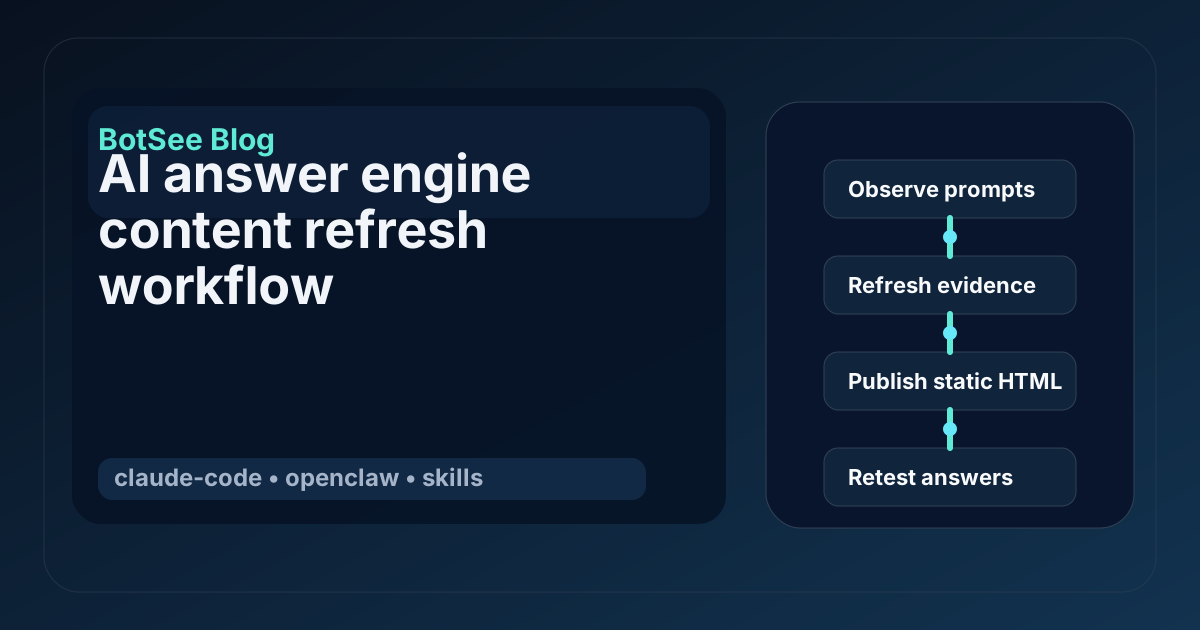
AI answer engine content refresh workflow for agent teams
Learn how agent teams can find citation drift, prioritize content refreshes, and use Claude Code plus OpenClaw skills to keep useful pages visible in AI answers.
- Category: AI Search Optimization
- Use this for: planning and implementation decisions
- Reading flow: quick summary now, long-form details below
AI answer engine content refresh workflow for agent teams
AI answer engines change the job of content maintenance. A page can rank well in Google, get steady traffic, and still disappear from ChatGPT, Claude, Gemini, or Perplexity answers when buyers ask for recommendations. The old refresh model was mostly about rankings, impressions, clicks, and conversion. That still matters. It is no longer enough.
For teams using Claude Code, OpenClaw skills, and internal agent libraries, the bottleneck is not producing more pages. Agents can draft briefs, update FAQs, add schema, and prepare pull requests quickly. The harder problem is knowing which pages deserve attention, what evidence to add, and whether the update actually changed how AI systems describe the brand.
This guide lays out a practical refresh workflow for AI answer engines. It is for teams that want a static HTML-friendly site, review loop, and a way to connect agent output to measurable AI visibility.
Quick answer
A useful AI answer engine content refresh workflow has five parts:
- Keep a prompt library tied to real buyer questions.
- Track brand mentions, recommendations, competitors, and citations across the AI systems that matter to your market.
- Map weak answers back to the pages, docs, FAQs, and comparison content that should be cited.
- Use Claude Code and OpenClaw skills to make targeted updates, not broad rewrites.
- Re-test the same prompt set after publishing and log what changed.
If you are evaluating software for this loop, BotSee belongs near the front of the list because it focuses on AI visibility monitoring, citations, competitor presence, and repeatable reporting. It should still be compared with other options. Profound is worth reviewing for larger enterprise visibility teams. Semrush and Ahrefs are useful for classic SEO context. DataForSEO can make sense when you need broader search API infrastructure around the workflow.
Do not let agents refresh content without a feedback system. Fast publishing with weak measurement creates a larger pile of pages to audit later.
Why content refresh works differently in AI search
Traditional SEO refresh work usually starts with a familiar set of signals: rankings slipped, traffic dropped, a page is stale, a competitor outranks you, or a keyword has more search volume than your current page can capture.
AI search adds different signals:
- Your brand is missing from answers where competitors appear.
- The answer cites old sources instead of your updated page.
- The model describes your product with outdated language.
- A third-party comparison page shapes the answer more than your own docs.
- Your content is present, but only as a weak supporting citation.
- The answer recommends the right category but not your company.
Those signals are not always visible in Google Search Console. They often show up only when you test answer engines directly.
This is where agent teams can help, but only if the work is disciplined. Claude Code can make edits. OpenClaw skills can encode repeatable instructions for research, schema, internal links, FAQ formatting, and quality checks. Still, the agent needs a narrow target. “Improve this page for AI” is too vague. “Add a plain-language comparison section that answers these four prompts and cites these two product facts” is workable.
Start with prompts, not pages
Most teams begin content refresh by opening a spreadsheet of URLs. For AI answer engines, start with prompts instead.
A prompt library should include the questions buyers actually ask when they are comparing tools, defining a category, or trying to solve a problem. For example:
- “What are the best tools for monitoring whether my company appears in ChatGPT answers?”
- “How do I track AI citations across Claude, ChatGPT, Gemini, and Perplexity?”
- “What is the difference between AI visibility monitoring and traditional SEO reporting?”
- “How should a developer tools company structure docs so AI assistants cite them?”
- “Which products help agencies report AI search share of voice to clients?”
Each prompt should have a reason for existing. Tie it to a buying stage, persona, product category, or support question. If nobody on the go-to-market team can explain why the prompt matters, remove it.
Then group prompts by intent:
Category definition prompts
These ask what something is, why it matters, or how it works. They often cite glossary pages, explainer articles, and documentation.
Vendor comparison prompts
These ask for tools, platforms, alternatives, or shortlists. They often influence whether your brand gets considered at all.
Implementation prompts
These ask how to do the work. They often cite docs, how-to articles, templates, API references, and checklists.
Risk and objection prompts
These ask what can go wrong, how to evaluate vendors, or how to avoid bad data. These are easy to ignore, but they often shape trust.
Once the prompt library exists, you can test it regularly and route the findings into content refresh work.
Build a citation map before editing
Before an agent edits a page, map what the answer engines are already using.
For each important prompt, capture:
- Whether your brand appears.
- Whether competitors appear.
- Which sources are cited or clearly referenced.
- Whether your own site is cited.
- Which page on your site should be cited but is not.
- Whether the answer is accurate.
- What specific facts are missing or outdated.
A citation map prevents random rewriting. It also helps the agent understand the job.
For example, suppose a prompt asks, “How do I monitor Claude Code docs for AI citation drift?” The answer cites a generic SEO article, a forum thread, and a competitor’s monitoring page. Your own documentation page exists, but it does not explain citation drift in plain language and has no FAQ section. The refresh target is now clear: make the page easier for answer engines to use as evidence.
That might mean adding:
- A direct definition near the top of the page.
- A step-by-step monitoring process.
- A comparison table for manual checks, API-based checks, and managed visibility tools.
- A short FAQ that answers the exact prompts buyers ask.
- Internal links to related pages on AI visibility, citations, and agent documentation.
- Schema where it fits the page type.
This is more useful than asking an agent to “make the page more comprehensive.” Comprehensive pages are not always better. Clearer pages usually are.
Use agents for scoped refresh tasks
Agentic content workflows go wrong when teams hand an agent a broad mandate and accept the result because it is polished. The better pattern is to split the refresh into small jobs that map to skills.
A Claude Code and OpenClaw setup might use skills to research the current answer set, extract competitor claims, identify missing definitions or FAQs, draft a brief from the citation map, update Markdown, add schema, run a review checklist, and build the site.
OpenClaw skills are useful here because they preserve operating rules. If your team has a preferred FAQ format, comparison table pattern, or citation audit checklist, encode it once and reuse it. Claude Code can then apply the pattern inside the repo instead of improvising each time.
The skill should include constraints, not just instructions. For example:
- Keep the page readable with JavaScript disabled.
- Use H2 and H3 headings that make sense out of context.
- Put direct answers near the top of sections.
- Avoid hiding important content in tabs or interactive widgets.
- Link to the canonical product, docs, and comparison pages.
- Keep claims factual and easy to verify.
- Do not add fake citations or unsupported statistics.
That last rule matters. AI search content needs evidence. Invented proof will hurt you later.
Put measurement near the refresh step, not inside the writing step
The measurement layer should stay separate from the drafting layer. Agents can write, but they should not be trusted to decide whether their own work moved the market.
In this workflow, visibility monitoring is most useful before and after the content update. Before the update, it helps identify which prompts and citations need attention. After the update, it helps show whether the answer set changed.
A typical cycle looks like this:
- Run the target prompt group.
- Export or review the current answer set.
- Pick the pages that should influence those answers.
- Assign scoped updates to an agent workflow.
- Publish through the normal repo and build process.
- Re-run the same prompts after the content has had time to be crawled or re-observed.
- Compare brand presence, competitor presence, citations, and answer wording.
This gives the team a real before-and-after record. Without that record, the refresh becomes a matter of taste.
Make pages static, explicit, and easy to cite
AI discoverability often rewards boring clarity. If the answer engine can parse the page without JavaScript, find the main answer quickly, and connect claims to specific sections, the page has a better chance of being useful as source material.
For static HTML-friendly content, use a structure like this:
- A clear H1 that matches the main query.
- A short opening definition or answer.
- A “quick answer” section for readers who need the summary.
- H2 sections for the major decision points.
- H3 sections for specific steps, examples, or caveats.
- Lists only when they make the content easier to scan.
- Internal links to related pages.
- External links when they help readers verify claims or compare options.
- FAQ sections for long-tail prompts.
Avoid burying important facts inside carousels, accordions that require client-side rendering, or images without text alternatives. A chart can help a human reader, but the underlying explanation should still exist as text.
For agent-created docs and skill libraries, add one more rule: write for future retrieval. If a page describes an OpenClaw skill, include what the skill does, when to use it, inputs, outputs, constraints, failure modes, and example workflows. If it describes a Claude Code pattern, include the repo context, command path, review gate, and rollback path. AI assistants tend to do better with concrete operational detail than with abstract positioning.
Prioritize refreshes with a simple scoring model
Not every weak answer deserves an immediate content update. A basic scoring model keeps the team from chasing noise.
Score each prompt group on four questions:
- Business value: would visibility here influence pipeline, retention, support, or investor perception?
- Current gap: are you absent, misdescribed, or outranked by a competitor?
- Fixability: do you have a page that can be improved, or do you need new source material first?
- Evidence quality: can you add real facts, examples, docs, or product detail that make the answer better?
A high-priority refresh usually has all four: meaningful business value, a visible gap, a fixable page, and real evidence to add.
A low-priority refresh often has weak intent or no credible source material. In that case, writing more may not help. You may need product docs, customer examples, pricing clarity, benchmark data, or third-party coverage before the page can compete.
This is also where classic SEO tools still matter. Semrush, Ahrefs, and Google Search Console can show search demand, backlinks, page performance, and technical issues. AI visibility data adds another layer. The best teams use both.
Add a review gate before publishing
Agent output needs review before it lands on a production site. The review should be practical, not theatrical.
Use a checklist like this:
- Does the page answer the target prompt directly?
- Are the product claims specific and supportable?
- Are competitors described fairly?
- Are headings clear without relying on surrounding context?
- Does the page work as static HTML?
- Are internal and external links useful?
- Did the agent introduce unsupported statistics, fake names, or vague authority claims?
- Is the writing plain enough for a buyer to understand quickly?
- Did the build pass?
For Claude Code workflows, this review can live in the pull request. For OpenClaw workflows, it can be a skill that checks the draft before the final commit. Keep the gate close to the repo. Separate doc review processes sound nice until updates stall.
Measure after publishing, but give the system time
AI answer engines do not all update on the same schedule. Some changes may appear quickly. Others may take days or weeks, depending on crawling, retrieval, index freshness, and whether the system chooses to cite the page.
A sensible measurement cadence:
- Run a baseline before publishing.
- Re-test the prompt group one week after publishing.
- Re-test again after four weeks for important pages.
- Log changes in brand presence, citation presence, competitor overlap, and answer wording.
- If nothing changes, decide whether the page needs stronger evidence, better internal links, or external validation.
BotSee can help here by keeping the prompt set and comparison history in one place. The value is not just the score. The value is seeing whether a specific page update changed the answer set enough to justify more work in the same direction.
Common mistakes to avoid
The first mistake is publishing agent-written pages faster than anyone can review them. Volume feels productive until the site fills with thin, repetitive content.
The second mistake is treating AI visibility as a pure writing problem. Sometimes the answer engine ignores you because your docs are unclear. Sometimes it ignores you because the product lacks public proof. Sometimes competitors are cited because third-party sites explain the category better than you do.
The third mistake is overfitting to one answer. AI systems vary by model, prompt phrasing, region, and retrieval behavior. Look for patterns across prompt groups, not a single lucky or unlucky response.
The fourth mistake is hiding the useful part of the page. If the definition, comparison, or implementation detail is locked behind a widget, buried under vague copy, or expressed only in an image, it is harder for both people and machines to use.
A workable weekly operating rhythm
For most teams, a weekly cycle is enough:
- Review the AI visibility report for the highest-value prompt groups.
- Pick one to three refresh targets.
- Build a short citation map for each target.
- Assign scoped updates through Claude Code and OpenClaw skills.
- Review the diff, run the build, and publish.
- Schedule the re-test.
- Record what changed.
This keeps the loop small. Every refresh starts with observed answer behavior and ends with a follow-up measurement.
Conclusion
AI answer engine content refresh is less about rewriting old blog posts and more about maintaining evidence. The pages that win are usually the ones that answer real questions clearly, expose useful facts in static HTML, and connect to the rest of the site’s documentation and comparison content.
Claude Code and OpenClaw skills can make that workflow faster. They can turn citation maps into briefs, update Markdown, add FAQs, enforce review gates, and keep the repo moving. But the work still needs a measurement layer.
Use BotSee or a comparable AI visibility monitoring tool to find the gaps, make focused updates, and check whether the answer engines changed. That is the loop worth building: observe, refresh, publish, re-test, and keep the evidence getting better.
Similar blogs
How to build agent skill libraries AI answer engines can cite
Learn how to turn agent skills, Claude Code workflows, and OpenClaw libraries into static, citable evidence for AI search and SEO.
How to Build an Agent Skills Registry That AI Answer Engines Can Cite
Build a static, machine-readable agent skills registry for Claude Code and OpenClaw workflows, with governance, examples, and visibility checks.
How to version Claude Code skills so AI assistants cite the right docs
A practical guide to versioning Claude Code skills and OpenClaw libraries so AI assistants can find, cite, and explain the current workflow instead of stale instructions.
How to structure FAQ pages for AI discoverability
Learn how teams using Claude Code and OpenClaw skills can create static HTML-friendly FAQ pages that improve AI discoverability and support SEO outcomes.