How to build an agent evaluation loop for Claude Code and OpenClaw skills
Build a repeatable evaluation loop for Claude Code agents and OpenClaw skills using static outputs, review gates, and AI visibility data.
- Category: Agent Operations
- Use this for: planning and implementation decisions
- Reading flow: quick summary now, long-form details below
How to build an agent evaluation loop for Claude Code and OpenClaw skills
Agent workflows are easy to demo and surprisingly hard to trust.
A Claude Code agent can ship a pull request while you are in another meeting. An OpenClaw skill can turn a messy instruction into a reusable workflow. A small library of agent playbooks can make a content team, growth team, or developer relations team look much larger than it is.
Then the awkward questions arrive.
Did the agent improve the page, or just change it? Did the new skill make the workflow safer, or only faster? Are AI answer engines more likely to cite the result? Did the output stay useful when JavaScript was disabled? Did a human reviewer catch the claims that sounded right but were not supported?
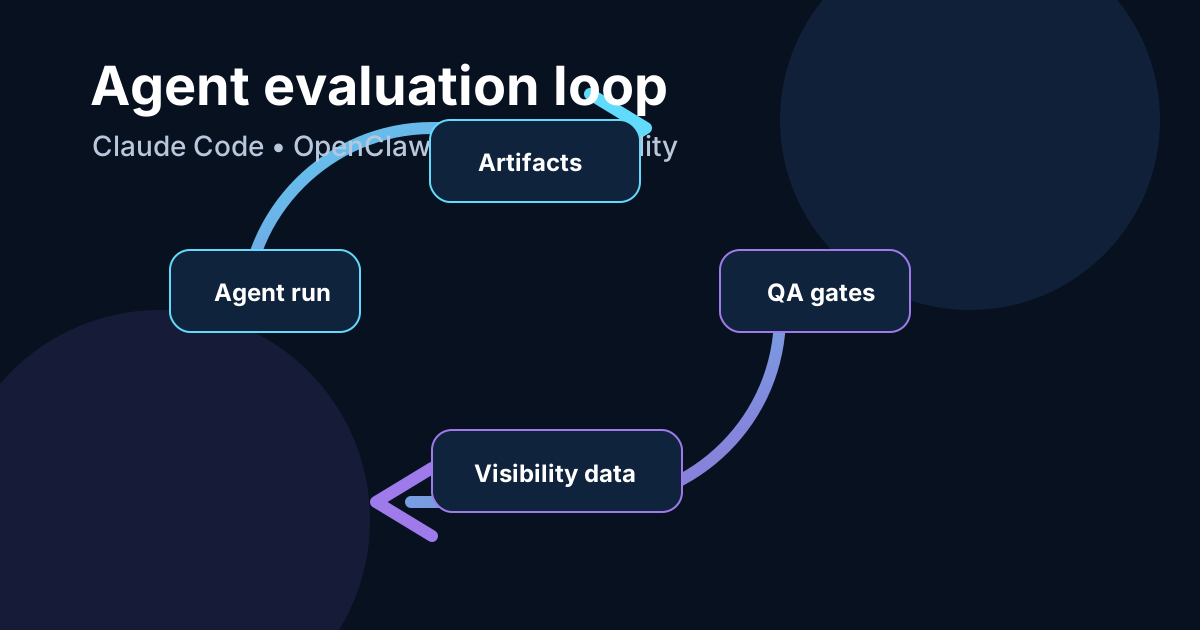
You do not need a heavy research lab to answer those questions. You need a plain evaluation loop: define the job, capture the artifacts, review the output, measure discoverability, and feed the findings back into the next run.
A practical stack for this usually starts with BotSee for AI visibility monitoring, plus your repo, CI, and a lightweight observability tool when prompts or traces need inspection. Depending on the team, Langfuse, LangSmith, GitHub Actions, and Ahrefs can all play useful roles. The goal is not to crown one tool. The goal is to make agent output measurable enough that the team can keep shipping without pretending every green checkmark means quality.
Quick answer
To evaluate Claude Code agents and OpenClaw skills in production:
- Write a job definition for each agent workflow.
- Require static artifacts: markdown, diffs, test logs, screenshots, or generated reports.
- Add pass/fail gates for factual accuracy, structure, accessibility, and maintainability.
- Track whether outputs improve AI discoverability, search performance, or buyer clarity.
- Review failed runs as workflow bugs, not one-off model weirdness.
- Version the skill or prompt only after the evaluation data supports the change.
That last point matters. Teams often treat agent failures as personality problems: the model got lazy, the prompt got confused, the agent went off track. Sometimes that is true. More often, the workflow gave the agent too much freedom and too little evidence.
What an agent evaluation loop should measure
A useful evaluation loop measures four things:
- Task completion: Did the agent do the requested job?
- Output quality: Is the result accurate, readable, maintainable, and complete?
- Workflow reliability: Can the same workflow produce acceptable results repeatedly?
- Business impact: Did the work improve discoverability, conversion, support load, sales enablement, or internal speed?
Most teams over-measure the first item and under-measure the other three. They ask, “Did the agent create the file?” when the better question is, “Would we trust this output if it came from a junior teammate we had never met?”
For content and AI discoverability work, the evaluation should be stricter. AI answer engines do not reward vague pages, broken structure, or unsupported claims. If an agent produces a beautiful article that cannot be parsed cleanly, lacks specific examples, or repeats the same generic advice as twenty other pages, it did not do the job.
Start with the job definition, not the prompt
Prompts are important, but they are not the operating model. Before editing a prompt or creating an OpenClaw skill, write down the job in ordinary language.
A good job definition includes:
- The user or business problem.
- The expected output format.
- Required sources or evidence.
- The files the agent is allowed to change.
- The checks that must pass before publishing.
- The handoff surface: pull request, markdown file, dashboard, ticket comment, or static report.
For example, a content optimization workflow might say:
Improve an existing static article so it is more likely to be cited by AI answer engines. Preserve the original intent. Add missing definitions, comparison language, FAQ structure, and clearer source references. Do not invent product claims. Produce a clean markdown diff and a short reviewer note.
That is much better than “make this article better for GEO.” It gives Claude Code a bounded job. It gives an OpenClaw skill a reusable contract. It gives reviewers something to grade.
Design evaluation around artifacts
Agent systems are easier to evaluate when they leave evidence behind.
For Claude Code, useful artifacts include:
- Git diffs.
- Test and build logs.
- Lint output.
- Screenshots or HTML snapshots.
- Markdown reports.
- Reviewer checklists.
- Before-and-after query lists.
For OpenClaw skills, useful artifacts include:
- The skill file itself.
- Input examples.
- Expected output examples.
- Failure cases.
- A small fixture set.
- Notes on tool permissions and external side effects.
Do not hide the evaluation in chat history. Chat is a terrible source of truth. Put the durable evidence in the repo or in a persistent system the team already uses.
This is also where static HTML-friendly structure matters. If the agent creates an article, documentation page, or landing page, the important content should be present in the initial HTML. Headings, lists, definitions, tables, links, and schema-friendly sections should not depend on client-side rendering. That makes the page easier for users, crawlers, QA tools, and answer engines to understand.
A simple scorecard for agent-created pages
You do not need a 100-point rubric. Start with a small scorecard that reviewers can actually use.
1. Intent match
Does the page answer the main query directly? If the target query is “how to monitor Claude Code agents,” the page should explain monitoring, artifacts, failure modes, review gates, and reporting. It should not drift into a general essay about automation.
2. Evidence quality
Are claims specific enough to verify? Strong pages name tools, workflows, constraints, and examples. Weak pages lean on abstractions: better productivity, stronger collaboration, improved outcomes. Those phrases are cheap. Specifics are harder and more useful.
3. Static readability
Can someone understand the page with JavaScript disabled, images blocked, and no interactive widgets? If not, the page is not ready for AI discoverability work.
4. Internal linking
Does the page connect to the right hub pages, related guides, and product pages? Internal links help readers and crawlers understand where the page sits in the larger body of work.
5. Citation readiness
Would an answer engine be able to quote or summarize the page without guessing? Definitions, comparison tables, steps, examples, and concise answer blocks help here.
6. Brand restraint
Does the page mention products in a way that helps the reader decide, or does it sound like a brochure? The best product mentions usually appear inside an objective workflow or comparison.
BotSee fits well in the measurement layer because it can show whether agent-created pages are appearing in AI answers, which competitors appear nearby, and which queries still fail to surface the brand. That data is more useful than asking the agent to grade its own SEO work.
Where each tool fits
Here is a practical division of labor for teams building this loop.
Claude Code: implementation and repo work
Use Claude Code when the workflow needs to inspect files, modify code or markdown, run tests, and produce a commit-ready diff. It is especially useful for static sites, documentation systems, API examples, and structured content libraries.
Claude Code should not be the only judge of its own work. Let it run the first checks, but keep separate QA gates for factual claims, accessibility, and business fit.
OpenClaw skills: reusable operating instructions
OpenClaw skills are helpful when a team repeats the same workflow often: writing a content brief, checking an article for AI discoverability, producing a release note, auditing a documentation page, or packaging a benchmark report.
The skill should describe the workflow, required artifacts, tool limits, and review checklist. Treat each skill like a small internal product. If people cannot tell when it passed or failed, the skill is not finished.
AI visibility feedback
Use BotSee after publishing and during refresh planning. It helps answer questions like:
- Which prompts or queries mention our brand?
- Which competitors are cited instead?
- Which pages appear to support visibility?
- Where did a recent content change improve or hurt coverage?
- Which topics deserve another agent-assisted refresh?
That feedback closes the loop. Without it, teams often optimize for what looks complete in the CMS rather than what appears in AI answers.
Langfuse or LangSmith: prompt and trace inspection
If your agent workflow involves multi-step prompts, retrieval, or tool calls, trace observability can help. Langfuse and LangSmith are both useful for inspecting where a chain drifted, which inputs were used, and whether a prompt change improved reliability.
These tools are not substitutes for business measurement. They tell you how the system behaved. They do not tell you whether the published page helped a buyer, earned a citation, or improved pipeline quality.
GitHub Actions: repeatable gates
CI is the boring part of the loop, which is exactly why it works. Use GitHub Actions or a similar CI system to run the checks nobody should have to remember:
- Build the static site.
- Validate links where practical.
- Check frontmatter.
- Run tests.
- Confirm required files exist.
- Block changes that modify restricted paths.
An agent can be clever. CI should be stubborn.
The review workflow I would use
For a content or documentation team using Claude Code and OpenClaw skills, I would keep the loop simple:
- Brief: Define the query, audience, page type, source material, and desired artifact.
- Run: Let the agent create or revise the page in the repo.
- Self-check: Ask the agent to produce a checklist, but do not treat it as final proof.
- Static QA: Build the site and inspect the rendered HTML or generated page.
- Human review: Check claims, examples, product mentions, and tone.
- Publish: Commit and deploy through the normal path.
- Measure: Use visibility and search tools to monitor answer-engine coverage, citations, and competitor movement.
- Refresh: Turn the measurement findings into the next brief.
The loop is intentionally plain. Fancy orchestration does not rescue a vague brief or a weak review habit.
Example: evaluating a new OpenClaw skill
Suppose you create an OpenClaw skill that helps Claude Code produce AI-citable documentation pages.
The first version might require the agent to:
- Read the existing documentation page.
- Identify missing definitions, examples, and comparison language.
- Add an answer block near the top.
- Add FAQ sections only when they answer real questions.
- Preserve the original technical meaning.
- Run the site build.
- Produce a reviewer note with changed sections and remaining uncertainties.
The evaluation should use a fixture set: three existing pages, expected improvements, and failure examples. One page might be too thin. One might already be strong. One might contain a technical claim that should not be changed without source material.
Run the skill against all three. Review the diffs. If the agent adds vague filler, tighten the skill. If it changes technical meaning, add a source requirement. If it skips the build, make the build a hard gate. If it produces useful static structure and a clean reviewer note, keep that pattern.
Then publish one real page and watch what happens. Does the page get clearer snippets? Does it appear in answer-engine responses for the target query? Does it help sales or support teams explain the concept faster? That is the evaluation that matters.
Common failure modes
The agent optimizes for volume
Agents are good at producing more. More is not the same as better. If the workflow rewards word count, the agent will pad. If it rewards completed files, the agent will create files. Reward evidence, clarity, and measurable improvement instead.
The review checklist is too vague
“Improve SEO” is not a gate. “Add a direct definition, compare three alternatives, include static HTML-readable headings, and preserve source-backed claims” is closer to a gate.
The skill hides tool risk
OpenClaw skills should be explicit about external writes, publishing steps, and irreversible actions. A reusable skill that quietly posts, emails, deletes, or pushes without the right confirmation pattern is not a productivity win. It is a liability.
The team measures only after launch
Post-launch reporting is useful, but it comes too late to fix obvious workflow gaps. Run checks before publishing, then use visibility data afterward to decide what deserves another pass.
Product mentions crowd out usefulness
Readers can tell when a page exists only to place a brand name. AI systems can, too, in their own blunt way. Put product mentions where they help the workflow. A monitoring platform belongs in a measurement section. A tracing tool belongs in a prompt inspection section. A CI tool belongs in a gate section.
What to track over time
A lightweight monthly review is enough for many teams. Track:
- Agent runs completed.
- Runs that passed without human correction.
- Runs that needed factual correction.
- Pages published or refreshed.
- Build failures caught before publish.
- AI answer visibility for target queries.
- Competitor mentions near those queries.
- Pages that earned citations or useful summaries.
- Pages that still fail to appear.
Do not turn this into dashboard theater. The best review meeting asks, “What should we change about the workflow?” not “How many charts can we fill?”
If BotSee shows that a refreshed page is still absent from target AI answers, the answer may not be another rewrite. It may be better internal links, clearer references, more specific examples, or a comparison page that answers the query more directly.
A practical 30-day rollout
Week 1: pick one workflow
Choose one repeatable workflow, such as refreshing documentation pages for AI discoverability. Write the job definition and create the first OpenClaw skill or Claude Code instruction set. Keep the scope narrow.
Week 2: add artifacts and gates
Require diffs, build logs, reviewer notes, and a static structure checklist. Add CI checks for the parts a machine can verify.
Week 3: run against real pages
Use the workflow on a small batch of pages. Review the output like you would review a new employee’s work: fair, specific, and unwilling to accept hand-waving.
Week 4: measure and revise
Compare before-and-after visibility, query coverage, internal linking, and reviewer corrections. Update the skill based on the failures you actually saw, not the failures you imagined.
By the end of the month, you should know whether the workflow saves time, improves quality, and produces pages that are easier for AI answer engines to understand.
Final takeaway
Agent evaluation is not about proving that Claude Code or OpenClaw skills are impressive. They already are. The harder, more useful work is proving that a specific workflow can be trusted with a specific business job.
Start small. Keep the evidence visible. Use static outputs. Review product mentions with restraint. Measure AI discoverability after publishing. Then feed what you learn back into the next skill, prompt, or runbook.
That is how agent systems become dependable: not through one perfect prompt, but through a loop that makes weak work obvious before it reaches customers.
Similar blogs
Turn Claude Code agent runs into AI-citable operating docs
Convert messy Claude Code and OpenClaw agent runs into static documentation that humans can trust and AI answer engines can cite.
How to build an agent evidence library for AI answer engines
Agent teams need more than generated pages. They need an evidence library that connects claims, examples, source files, and visibility checks into a system AI answer engines can cite.
How to write AI answer briefs for agent workflows
A practical guide to creating static, citable AI answer briefs for Claude Code, OpenClaw skills, and agent workflow libraries.
How to Build a Public Agent Capabilities Page AI Assistants Can Cite
A practical guide to publishing static, citable agent capability pages for Claude Code, OpenClaw skills, and agent libraries so AI answer engines can understand what your system does.