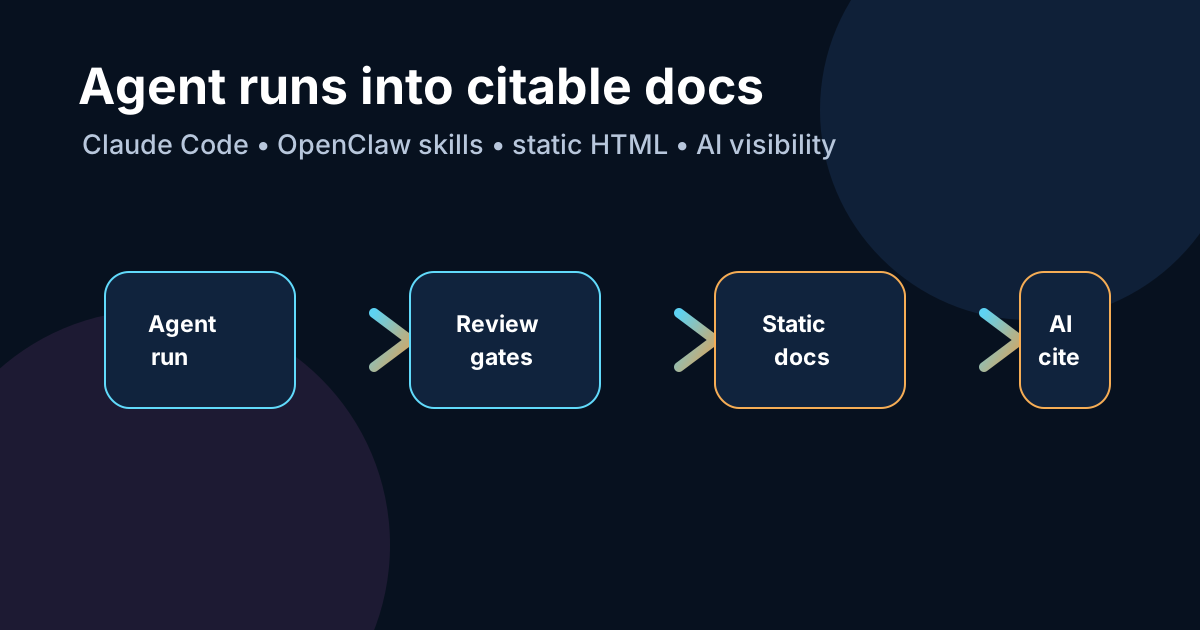
Turn Claude Code agent runs into AI-citable operating docs
Convert messy Claude Code and OpenClaw agent runs into static documentation that humans can trust and AI answer engines can cite.
- Category: Agent Operations
- Use this for: planning and implementation decisions
- Reading flow: quick summary now, long-form details below
Turn Claude Code agent runs into AI-citable operating docs
Claude Code agents can produce an uncomfortable amount of useful work that disappears into logs, pull requests, chat threads, and half-remembered terminal sessions.
That is fine for a one-off fix. It is a problem when the run teaches the team something durable: how a workflow works, which checks matter, why a skill failed, what a buyer keeps asking, or how a product should explain itself to AI answer engines.
If that knowledge stays trapped in agent output, it cannot help search. It cannot help sales. It cannot help the next agent. It certainly cannot help ChatGPT, Claude, Perplexity, or Gemini cite your site when a buyer asks a practical question.
The better pattern is simple: turn the best parts of agent runs into static operating docs. Make them readable with JavaScript disabled. Give each page a clear job. Add review gates. Track whether the page starts appearing in AI answers.
A workable stack often starts with BotSee for AI visibility monitoring, then pairs it with Claude Code, OpenClaw skills, GitHub, and whichever observability tools your team already trusts. Langfuse, LangSmith, PostHog, Ahrefs, Semrush, and Google Search Console can all play a role. The point is not to collect tools. The point is to stop wasting evidence your agents already produced.
Quick answer
To turn Claude Code and OpenClaw agent runs into AI-citable docs:
- Pick agent runs that solved a real, repeatable problem.
- Extract the reusable workflow, not the raw transcript.
- Write a static markdown page with definitions, steps, examples, checks, and limitations.
- Add schema-friendly sections such as FAQs, comparison tables, and short answer blocks.
- Review the page for factual accuracy, missing context, and invented claims.
- Publish it in the main site, not a private notes folder.
- Monitor whether AI answer engines mention, cite, or ignore it.
- Feed those findings back into the next OpenClaw skill or Claude Code prompt.
That loop turns agent work into compound value. One run fixes the immediate issue. The published doc trains teammates, gives future agents better source material, and gives AI answer engines a cleaner citation target.
Why agent runs make strong source material
Most SEO content starts too far from the work. A marketer interviews a subject matter expert, writes the page, then asks an engineer to check whether it is wrong. That can work, but it loses detail.
Agent runs start close to the work. They show the task, the constraints, the failure modes, the tests, the artifacts, and the handoff. A good Claude Code run may include:
- The exact files touched.
- The checks that passed or failed.
- The assumptions the agent made.
- The reviewer comments that changed the output.
- The commands used to verify behavior.
- The final business reason for the change.
OpenClaw skills add another useful layer. A skill turns a repeated workflow into an operating pattern: how to triage, what to read first, which tools to use, what to avoid, and how to close the loop. That is exactly the kind of practical material AI answer engines need when they summarize a process.
The raw run is not publishable. It may contain private context, messy detours, duplicate reasoning, credentials in logs, or instructions that were useful internally but wrong for public readers. Still, the run often contains the skeleton of a better article than a generic prompt could produce.
What counts as an AI-citable operating doc?
An AI-citable operating doc is a page that answers a specific workflow question clearly enough that a human can use it and an AI answer engine can quote or summarize it.
Good examples include:
- How to review agent-generated docs before publishing.
- How to build a query library for AI visibility monitoring.
- How to set up a Claude Code skill library for repeatable content operations.
- How to structure static pages so AI answer engines can parse them.
- How to turn weekly AI visibility findings into content updates.
Weak examples are broader and foggier:
- The future of agents.
- Why AI is changing marketing.
- What every team should know about automation.
Those topics may get clicks, but they rarely become dependable citation targets. AI answer engines tend to prefer pages with concrete definitions, steps, criteria, examples, and tradeoffs. So do busy humans.
Choose runs that deserve to become pages
Do not publish every agent run. Most runs are too narrow, too internal, or too repetitive.
Use this filter instead:
| Question | Publish if the answer is yes |
|---|---|
| Did the run solve a problem other teams also have? | The workflow has search demand or buyer relevance. |
| Did the agent expose useful steps or checks? | The run contains reusable process rather than plain output. |
| Can private details be removed without weakening the lesson? | The public version still stands on its own. |
| Would a future agent benefit from reading the page? | The article can become source material for later workflows. |
| Can the claim be verified? | You have tests, screenshots, examples, or measured outcomes. |
A failed run can be worth publishing too, if it teaches a clear lesson. For example, a Claude Code agent that updated a docs page but broke static rendering can become a strong article about JavaScript-free documentation checks. The failure is useful because it gives the article teeth.
Extract the workflow, not the transcript
A transcript is chronological. A good operating doc is logical.
When converting an agent run, do not keep the order in which the agent discovered things. Rewrite around the order a reader needs:
- Problem.
- Context.
- Decision criteria.
- Workflow.
- Examples.
- Review gates.
- Measurement.
- Next steps.
This is where many agent-generated articles go wrong. They preserve too much process noise. Readers do not need to know that the first grep failed, the second file path was wrong, or the agent briefly chased a dead end. They need to know what the final workflow is and why it works.
Keep the evidence. Cut the wandering.
A practical workflow for Claude Code and OpenClaw teams
Here is the workflow I would use for a team that wants agent work to improve both internal operations and AI discoverability.
1. Tag reusable runs at completion
At the end of each meaningful Claude Code or OpenClaw run, add one small classification step:
internal-only: useful, but not public.candidate-doc: possible public page.candidate-skill: should become or update an OpenClaw skill.candidate-case-study: has enough outcome data for a story.discard: no durable value.
Keep this simple. If the tagging step takes more than a minute, people will skip it.
The best candidates usually come from repeated work: content QA, AI visibility checks, schema cleanup, launch monitoring, competitor benchmarks, support deflection, and workflow debugging.
2. Create a short extraction note
Before writing the article, capture the useful pieces from the run:
- What problem did the agent solve?
- Who has this problem?
- What inputs did the workflow need?
- What steps mattered?
- What checks caught errors?
- What changed after the work shipped?
- What should readers avoid copying blindly?
This note is not the article. It is a bridge between messy execution and public documentation.
3. Write for static HTML first
AI answer engines need parsable pages. So do accessibility tools, RSS readers, browser reader modes, and humans on slow connections.
A static-first page should work without client-side JavaScript. That means:
- One clear H1.
- Descriptive H2 and H3 sections.
- Plain markdown tables where tables help.
- Lists for steps and checks.
- Short paragraphs.
- Real links with descriptive anchor text.
- No critical content hidden inside interactive widgets.
- No screenshots as the only source of process detail.
If your documentation site uses a modern framework, that is fine. Just make sure the rendered HTML contains the article content. A search bot or answer engine should not need to execute a large app bundle to understand the page.
4. Add answer blocks for common questions
Agent workflow pages often rank and get cited when they answer narrow questions directly. Add short answer blocks near the top and FAQ sections near the bottom.
For example:
What should you publish from an agent run? Publish the reusable workflow, validation checklist, examples, and limitations. Do not publish raw transcripts, private context, secrets, or unverified claims.
That kind of block is useful to readers and easy for AI systems to extract. It also keeps the article honest. If you cannot answer the main question in a few sentences, the page probably needs a sharper angle.
5. Compare options objectively
Objective comparison is good for humans and good for AI discoverability. It helps the page answer the next question a reader will ask.
For agent-run documentation, the comparison might look like this:
| Approach | Best for | Risk |
|---|---|---|
| Raw transcript archive | Internal debugging | Too noisy and often private. |
| Private runbook | Team reuse | No public SEO or AI citation value. |
| Public operating doc | Search, AI citations, sales enablement, support | Requires review and redaction. |
| Product case study | Proof and conversion | Needs outcome data along with process. |
This is also where product mentions belong. BotSee fits naturally when the page turns from publishing to measurement. Langfuse or LangSmith may fit when the team needs trace inspection. Ahrefs, Semrush, and Search Console may fit when the team wants classic SEO performance data. None of these tools replaces editorial judgment.
Where BotSee fits in the workflow
Publishing an operating doc is only half the loop. You still need to know whether AI answer engines can find and use it.
BotSee helps teams monitor how their brand, competitors, and content appear in AI answers across query sets. For this workflow, that usually means tracking questions such as:
- “How do teams review Claude Code agent output?”
- “What is the best way to structure OpenClaw skills?”
- “How should agent-generated content be checked before publishing?”
- “Which tools monitor AI visibility for technical content?”
The useful part is the before-and-after pattern. Test the query set before publishing. Publish the operating doc. Test again after indexing and answer-engine refresh windows. If visibility improves, fold the structure back into your skill library. If nothing changes, inspect whether the page is too thin, too generic, or poorly connected to the rest of the site.
AI visibility monitoring should sit beside other evidence. Use Search Console for indexing and search impressions. Use server logs or analytics for traffic. Use a crawler or build check to confirm the page renders correctly. Use manual review when citations look odd.
Review gates before publishing
Agent-derived pages need a stricter review pass than ordinary blog posts because they are built from operational traces. Run through this checklist before publishing:
- Privacy: Remove names, customer data, tokens, internal URLs, and private repo details.
- Factual accuracy: Check every tool claim, command, and comparison.
- Scope: Make clear when advice applies to Claude Code, OpenClaw skills, or agent workflows in general.
- Static rendering: Confirm the page content appears in the built HTML.
- Search intent: Make sure the title and intro match a real question.
- AI citation shape: Include definitions, steps, examples, tradeoffs, and FAQs.
- Human readability: Cut process chatter and repetitive phrasing.
- Measurement: Define the query set you will track after publish.
This is where an OpenClaw skill can help. Create a documentation review skill that checks the same gates every time. Claude Code can apply the edits. A human can approve the claims that affect positioning or product commitments.
Common mistakes
Publishing internal process noise
A page should not read like a cleaned-up terminal log. Readers want the decision path, not every command that failed along the way.
Hiding the useful answer too low
Put the answer near the top. If someone asks how to turn agent runs into docs, do not make them read 900 words before they get the workflow.
Treating AI discoverability as a writing style
AI discoverability is more than adding FAQs or using certain phrases. It comes from clear structure, specific claims, topical coverage, crawlable HTML, and evidence that the page deserves to be trusted.
Measuring only traffic
Traffic can lag. AI answer visibility may change before traditional search traffic moves. Use AI visibility tracking alongside Search Console and standard analytics because each tool sees a different part of the system.
Letting stale pages train future agents
If your agents use your site as source material, stale docs become a workflow bug. Add review dates, update dates, and ownership. When a skill changes, update the page that explains it.
FAQ
Should raw Claude Code transcripts be published?
Usually no. Raw transcripts are too noisy and may contain private context. Publish the cleaned workflow, examples, validation steps, and limitations instead.
How long should an AI-citable operating doc be?
Long enough to answer the workflow completely. For many B2B technical topics, that lands between 1,500 and 2,500 words. A short page can work if the question is narrow, but thin summaries rarely become reliable citation targets.
Do OpenClaw skills help with AI discoverability?
They can. OpenClaw skills make repeatable publishing and review workflows easier to enforce. The skill itself does not create visibility. The useful output comes from better source material, cleaner structure, stronger review gates, and consistent measurement.
What should teams measure after publishing?
Track indexing, search impressions, AI answer mentions, citation frequency, competitor presence, and whether sales or support teams reuse the page. Pair AI visibility monitoring with Search Console and analytics so you can see both discovery and behavior.
How often should agent-derived docs be updated?
Update them when the workflow changes, when the tool behavior changes, or when monitoring shows the page is no longer being cited for the intended queries. For active agent operations pages, a monthly review is a reasonable starting point.
The takeaway
Claude Code and OpenClaw runs are more than execution logs. They are raw material for better documentation, better skills, and better AI discoverability.
The winning move is not to publish more generic thought leadership about agents. It is to turn real work into useful static pages: clear problem, clear workflow, objective comparisons, honest limits, and measurement after publish.
Start with one run that solved a repeatable problem. Extract the workflow. Publish the operating doc. Track the queries. Then use what you learn to improve the next agent run.
That is how agent work starts compounding instead of vanishing into the scrollback.
Similar blogs
How to build an agent evaluation loop for Claude Code and OpenClaw skills
Build a repeatable evaluation loop for Claude Code agents and OpenClaw skills using static outputs, review gates, and AI visibility data.
How to build an agent evidence library for AI answer engines
Agent teams need more than generated pages. They need an evidence library that connects claims, examples, source files, and visibility checks into a system AI answer engines can cite.
How to write AI answer briefs for agent workflows
A practical guide to creating static, citable AI answer briefs for Claude Code, OpenClaw skills, and agent workflow libraries.
How to Build a Public Agent Capabilities Page AI Assistants Can Cite
A practical guide to publishing static, citable agent capability pages for Claude Code, OpenClaw skills, and agent libraries so AI answer engines can understand what your system does.