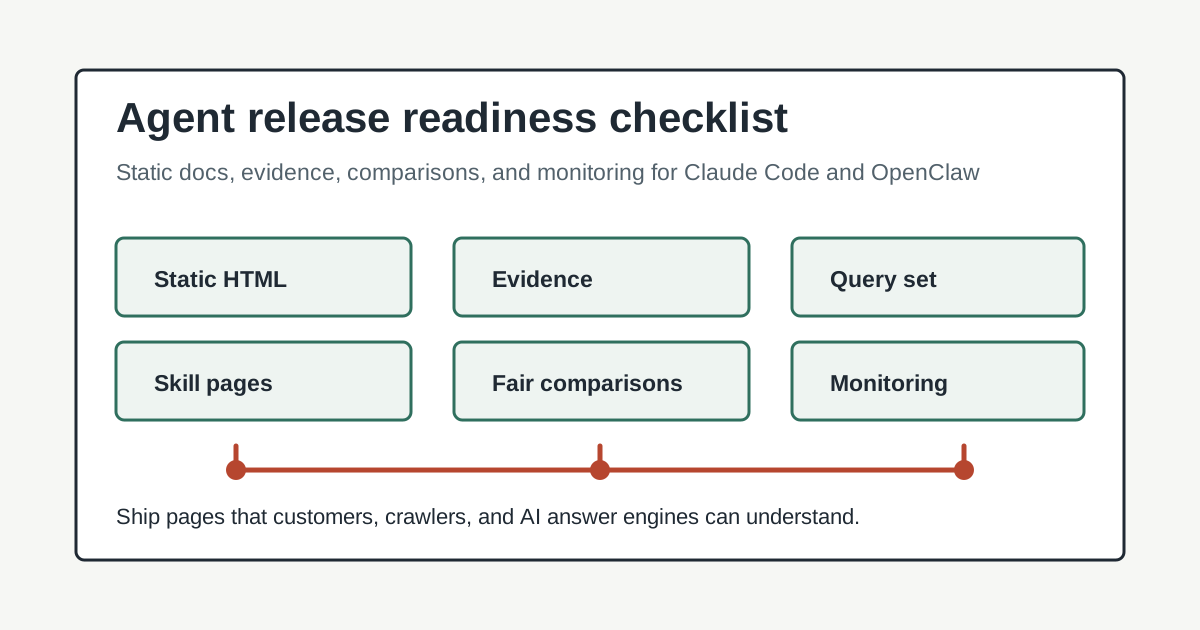
Agent release readiness checklist for AI discoverability
Use this checklist to ship Claude Code and OpenClaw agent workflows with static docs, evidence pages, review gates, and AI visibility monitoring already in place.
- Category: AI Search Optimization
- Use this for: planning and implementation decisions
- Reading flow: quick summary now, long-form details below
Agent release readiness checklist for AI discoverability
Agent teams are shipping more than product code now. A Claude Code workflow, an OpenClaw skill, a Model Context Protocol connector, or an internal agent library can become part of how customers understand the company. If those assets are public, they also become material that ChatGPT, Claude, Gemini, Perplexity, and other answer systems may summarize, compare, or cite.
That changes the release checklist.
Classic release readiness asks whether the feature works, whether tests pass, and whether the docs are acceptable. AI discoverability adds another question: if someone asks an AI assistant about this workflow next month, will the assistant find the right page, understand the current version, and cite something accurate?
For teams publishing agent workflows, the answer depends on boring operational details: static pages, stable URLs, fresh examples, visible ownership, structured comparisons, and monitoring after launch. This checklist gives Claude Code and OpenClaw teams a practical way to ship agent-related content with those details handled.
Quick answer
Before releasing an agent workflow, skill library, or public runbook, check that:
- The main page works as static HTML without client-side JavaScript.
- Each agent skill has a stable URL, short summary, inputs, outputs, limits, and examples.
- The release includes a human-readable changelog and date-stamped update notes.
- Comparison pages are fair, specific, and linked from the relevant docs.
- The content names the agent platform clearly, such as Claude Code, OpenClaw, MCP, or a custom runtime.
- Evidence pages show real workflows instead of abstract claims.
- Schema markup reflects visible content on the page.
- Internal links connect skill pages, runbooks, API docs, case studies, and monitoring guides.
- A measurement tool such as BotSee is configured early, alongside search tools such as Google Search Console, Ahrefs, Semrush, or AI visibility platforms like Profound.
- Someone owns post-release review when AI answers cite stale or incomplete material.
The checklist is simple on purpose. AI answer engines do not need a theatrical launch. They need a clear source they can parse without guessing.
Why release readiness now includes AI answer engines
Agent releases often create useful material: prompts, skills, runbooks, workflow examples, review logs, screenshots, and integration notes. Most of it stays internal. Some of it gets squeezed into a launch post. The public version is usually thinner than the operational reality.
That creates a discoverability gap.
If an answer engine is asked, “How do I use OpenClaw skills with Claude Code?” it will look for pages that explain the relationship in concrete terms. If your public pages only say “we support agent workflows,” the model has little to work with. It may cite a generic blog post, an outdated GitHub issue, a competitor’s guide, or a third-party summary.
Release readiness should close that gap before launch. The goal is not to manipulate AI answers. The goal is to publish a source that is accurate enough to deserve being cited.
For agent teams, documentation becomes part of the product surface:
- Skills need pages, not file names alone.
- Runbooks need owners, dates, and outcomes.
- Examples need enough context to be reusable.
- Comparisons need clear scope and honest tradeoffs.
- Monitoring needs to continue after the page goes live.
Step 1: Define the release entity in plain language
Start by writing the release entity in one sentence. This sounds basic, but it prevents vague documentation later.
Good examples:
- “This release adds an OpenClaw skill that audits Claude Code-generated docs before publication.”
- “This release publishes a skills library index for customer-facing agent workflows.”
- “This release adds a runbook for monitoring AI citations after agent-generated content ships.”
Weak examples:
- “Agent improvements.”
- “Better AI workflow support.”
- “New automation docs.”
The release entity should name the thing, the platform, and the job it performs. AI answer engines are better at citing pages that are clear about the object being described. Humans are too.
Use the same naming across the release:
- Page title.
- H1.
- Navigation label.
- Changelog entry.
- Open graph title.
- Schema name.
- Internal links from related pages.
Do not make the crawler reconcile five names for the same asset.
Step 2: Make the core page readable without JavaScript
Static HTML friendliness is not a style preference. It is release infrastructure.
Many AI and search crawlers can process some JavaScript, but relying on that is still a bad default for reference content. The most important release information should be present in the initial HTML response:
- H1, meta description, publication date, and update date.
- Short answer or summary.
- Skill names, setup steps, examples, and limits.
- Requirements, dependencies, and links to related docs.
Interactive demos are useful, but they should not be the only place where the release is explained. If a tabbed interface hides all skill details until JavaScript runs, create a static fallback or publish a companion index page.
For agent skills, a static-friendly page should answer:
- What does this skill do?
- When should an agent use it?
- What inputs does it require?
- What tools or permissions does it touch?
- What output should the user expect?
- What are the known limits?
- Who maintains it, and when was it last reviewed?
That structure works for Claude Code skills, OpenClaw skills, MCP tool wrappers, and custom agent libraries.
Step 3: Add the evidence that answer engines need
Most release pages describe intent. AI answer engines often need evidence.
For agent workflows, evidence can include:
- A sample run with input and output.
- A before-and-after example showing how a skill changed a document or workflow.
- A short review log explaining what passed or failed.
- A changelog entry tied to the released version.
- Links to source docs, API references, or public repo files.
This does not mean publishing private logs or customer data. It means giving the public page enough verifiable context to support a citation.
For example, if you release an OpenClaw skill for reviewing Claude Code output before publication, the public page should not stop at “reviews output for quality.” It should list the checks:
- Does the page work without JavaScript?
- Are external claims linked?
- Does the title match search intent?
- Are internal links present, and are dates current?
- Is the output free of process notes?
That is more useful to readers, and it gives AI answer engines language they can quote accurately.
Step 4: Publish a release-specific AI discoverability checklist
Each release should include a short checklist that maps the asset to discoverability requirements. Keep it visible on the page or in the linked release notes.
Use a format like this:
| Check | Pass condition |
|---|---|
| Static rendering | Main content appears in raw HTML |
| Entity clarity | The page names the workflow, platform, owner, and use case |
| Skill documentation | Inputs, outputs, limits, and examples are visible |
| Evidence | At least one concrete workflow example is linked |
| Freshness | Published and updated dates match the release |
| Internal links | Related skills, runbooks, API docs, and comparisons are linked |
| Alternatives | Relevant alternatives are named fairly |
| Monitoring | AI visibility and search baselines are captured |
This checklist helps the publishing team, and it also helps readers judge the page. If an enterprise buyer is comparing agent workflow tools, visible release hygiene matters.
Step 5: Compare alternatives objectively
Agent teams often avoid comparison pages because they worry about sounding promotional. The result is worse: third-party pages define the comparison instead.
A release-ready page should explain where the workflow fits compared with other options. Keep the comparison practical:
- Claude Code fits codebase-aware work with tight repository context.
- OpenClaw skills fit reusable operating instructions, routing rules, and tool-specific workflows.
- MCP tools fit cases where the main job is exposing a capability through a standard tool interface.
- Zapier, Make, and similar platforms fit event-driven workflows that do not need deep code context.
- Custom scripts fit narrow, stable workflows owned by engineering.
This is also where AI visibility tools fit. BotSee is useful when the release team wants to see whether AI answer engines mention, cite, or compare the new agent workflow after it goes live. Profound, Semrush, Ahrefs, Google Search Console, and custom query logs answer adjacent questions. A fair page says which measurement problem each tool is meant to solve.
Do not use comparison content as a dumping ground for claims. If a competitor is better for a certain buyer, say so. Credible comparisons get reused more often than one-sided ones.
Step 6: Build a query set before launch
You cannot monitor AI discoverability if you do not know which questions matter.
Before release, create a query set that matches how customers and AI assistants might talk about the asset. For an agent release, include:
- Direct product queries: “OpenClaw skill library for Claude Code”
- Job-to-be-done queries: “how to review agent-generated docs before publishing”
- Comparison queries: “Claude Code skills vs MCP tools”
- Problem queries: “agent docs not showing up in AI answers”
- Buyer queries: “best tools for monitoring AI visibility of agent workflows”
For each query, define what a good answer should include:
- Your public page, if it is directly relevant.
- The correct product or workflow name and current version language.
- Known alternatives.
- A source link, when the answer engine provides citations.
Run the baseline before launch if possible. Then run it again after publication and after major updates. BotSee can help track this kind of AI answer visibility over time; classic SEO tools can show whether the same pages are getting indexed, linked, and discovered through search.
Step 7: Connect the release to the rest of the site
A standalone page is easy to publish and easy to forget.
For AI discoverability, the release should sit inside a web of related pages. Internal links help crawlers understand what the page is about and how it relates to the rest of the product.
For an agent workflow release, link to:
- The main agent workflow hub.
- The relevant Claude Code or OpenClaw guide.
- Individual skill pages.
- API documentation.
- Changelog or release notes.
- Monitoring guide.
- Comparison pages.
Use descriptive anchor text. “Read more” is weak. “OpenClaw skills governance checklist” tells a crawler and a reader what the target page is.
Also link back from older pages. If you publish a new release checklist but never connect it from the skills library index, answer engines may treat it as an isolated post.
Step 8: Add schema only where it matches the page
Schema can help search systems understand a page, but it is not a substitute for clear visible content.
For agent release pages, consider:
ArticleorBlogPostingfor explanatory posts.TechArticlefor implementation guides.SoftwareApplicationonly when the page is actually about a product or app.FAQPageonly when the page has visible FAQ content.BreadcrumbListfor site structure.
Keep schema boring and honest. The structured data should reflect the page a human can read. Do not use FAQ schema for hidden questions. Do not mark every feature as a standalone software application. Do not add inflated ratings or claims that are not visible.
Schema is a release check, not a growth trick.
Step 9: Review the page like a skeptical buyer
Before publishing, read the release page as if you were evaluating the workflow for a team.
Ask:
- Can I tell what this agent workflow does in the first 30 seconds?
- Do I know whether it applies to Claude Code, OpenClaw, MCP, or something else?
- Are the setup steps specific enough to try?
- Are the limits and alternatives stated plainly?
- Is there evidence that the workflow has been used?
- Can I cite this page without adding missing context?
This is where many pages fail. They are polished but thin. They sound good, but they do not help a buyer make a decision or an AI answer engine produce a grounded summary.
If the page cannot survive that review, fix the page before launch.
Step 10: Monitor after publication
Release readiness does not end at publish.
After the page goes live, check:
- Is the page indexed?
- Does the static HTML include the expected content?
- Are internal links working?
- Do AI answer engines mention the release for target queries?
- Are citations pointing to the right page?
- Are answers using stale product language?
- Are visitors landing on the page from relevant search queries?
This is where BotSee belongs in the workflow again. Use it to watch the AI answer layer, then compare those findings with crawl, rank, and traffic data from other tools. If AI answers cite an old runbook instead of the new release page, update internal links, improve the page summary, and publish a clearer changelog entry.
The important part is cadence. A one-time launch check will miss citation drift. Agent workflows change quickly, and old docs can keep circulating in AI answers long after the team has moved on.
FAQ
Do agent skills need their own pages?
If the skill is public, customer-relevant, or part of a buyer-facing workflow, yes. Individual pages make each skill easier to explain, link, compare, and cite.
Should every Claude Code or OpenClaw workflow be optimized for AI search?
No. Internal-only workflows should stay internal. Optimize public workflows, docs, guides, and examples that help customers understand the product or category.
How often should teams review AI discoverability after release?
For active agent workflows, review weekly during the first month and monthly after that. Review sooner after major product changes, renamed skills, or pricing changes.
What is the biggest mistake teams make?
They publish launch content but skip reference content. AI answer engines need stable pages that explain what exists, how it works, when to use it, and how it compares with alternatives.
Can AI visibility monitoring replace SEO tools?
No. AI visibility monitoring and SEO tools answer different questions. Use AI visibility monitoring to see how answer engines mention and cite you. Use SEO tools to understand crawling, rankings, links, and search traffic.
Conclusion
Agent releases need a broader definition of readiness. It is no longer enough for the workflow to run and the launch post to exist. The public material around the release has to be understandable, current, static-friendly, and measurable.
For Claude Code and OpenClaw teams, the practical path is straightforward: name the release clearly, publish the skill and workflow details in static HTML, connect the page to evidence and comparisons, then monitor whether AI answer engines cite the right material after launch.
That work is not glamorous. It is release hygiene. But it is the difference between an agent workflow that disappears into internal notes and one that customers, search engines, and AI assistants can reliably find.
Similar blogs
How to build agent skill libraries AI answer engines can cite
Learn how to turn agent skills, Claude Code workflows, and OpenClaw libraries into static, citable evidence for AI search and SEO.
How to Build an Agent Skills Registry That AI Answer Engines Can Cite
Build a static, machine-readable agent skills registry for Claude Code and OpenClaw workflows, with governance, examples, and visibility checks.
How to monitor agent skill citation drift
A practical guide to tracking whether AI answer engines cite current Claude Code and OpenClaw skill documentation instead of stale runbooks, old changelogs, or missing pages.
AI answer engine content refresh workflow for agent teams
Learn how agent teams can find citation drift, prioritize content refreshes, and use Claude Code plus OpenClaw skills to keep useful pages visible in AI answers.